
HTTP 200 establishes transport success — not commercial continuity
The HTTP specification defines 200 OK as a successful response to a request. That is an important protocol fact: the server handled the request and returned a representation.
It is not a statement about the commercial meaning of the destination.
For an affiliate publisher, several additional questions determine whether the recommendation is still functioning as intended:
- Where did the reader ultimately land?
- Does that destination still match the promise made by the article, button, or CTA?
- Is the referenced product, offer, program, or merchant path still available?
- Can the affiliate or tracking path be verified with enough confidence to trust the result?
The protocol definition is available in RFC 9110, §15.3.1 — 200 OK.
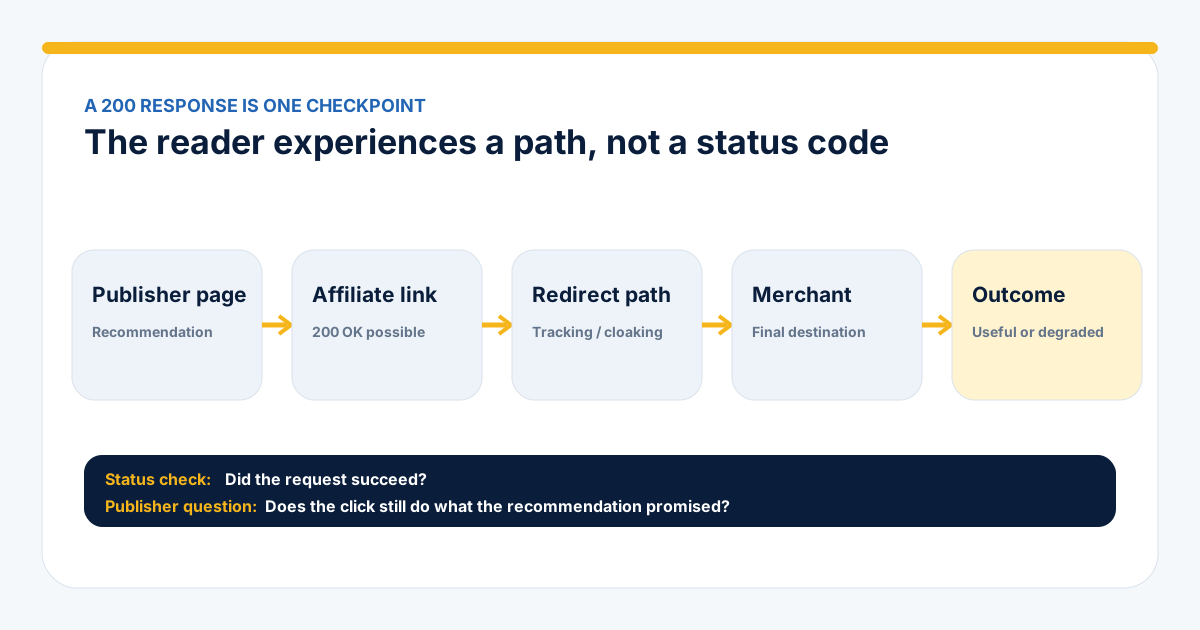
A monetization path contains several independent checkpoints
Observe the publisher recommendation
Start with the visible, clickable recommendation in the context where a reader encounters it.
Resolve the link path
Follow qualifying redirects or cloaked paths far enough to establish the external commercial destination.
Verify the destination
Inspect the final destination behavior, product or offer state, and whether destination intent has been preserved.
Classify the evidence
Separate strong commercial failures from verification uncertainty and healthy observations.
Prioritize publisher action
Put the strongest evidence first and attach a repair or review recommendation when the evidence supports one.
A failure at any later checkpoint can exist behind a technically successful request at the first checkpoint.
Three URLs answer three different questions
Affiliate Link Audit preserves three distinct URL truths during analysis because each represents a different point in the path:
Publisher link
The literal URL present in the publisher's page — the destination the content asks the reader to click.
See the audit scopeResolved commercial destination
The merchant or network destination established after resolving redirects or cloaked paths. This answers where the link is intended to send the reader before deeper verification.
See the production evidenceFinal verification destination
The URL reached during the deeper destination check. Additional redirects can make this different from the resolved destination and expose intent loss that the original URL alone cannot show.
See the customer outputKeeping those stages separate allows the audit to identify *where* the path changed instead of treating the original href as the whole truth.
Four recurring failure patterns
The page loads; the product is unavailable
A merchant can retain an old product page indefinitely while the product itself is no longer available. Transport is healthy; the recommendation is not actionable.
See the benchmarkThe deep link becomes a homepage
Every redirect can succeed while a reader who clicked for a specific product or offer lands at a generic storefront. Transport succeeded; destination intent did not.
See the travel evidenceThe commercial program changes behind the link
Offers expire, merchants move, and legacy redirect infrastructure can continue answering after the commercial context has changed.
See what the audit followsVerification remains incomplete
Bot protection, timeouts, redirect behavior, or merchant controls can prevent a confident automated conclusion. The correct result is an explicit review state, not an invented Broken or Healthy classification.
See how uncertainty is reportedA production failure shape hidden behind a successful response
This product-safe example uses the same unavailable-product evidence shape represented in the 2026 benchmark and validated sample-report model. Publisher and product identifiers are intentionally omitted.
Why the distinction matters at production scale
The 2026 benchmark covered 765 completed publisher scans, 21,318 rendered pages, and 14,092 monetized anchors. It produced 1,401 customer-facing Broken or Needs Attention findings.
The two largest evidence classes were not simple unreachable URLs. That is why the audit cannot be reduced to status-code checking: the important distinction often appears only after resolution, destination inspection, and evidence classification.
Broken, Needs Attention, and Healthy are evidence decisions
A confirmed unavailable product can support Broken. A parked domain can support Broken. A deep link that repeatedly resolves to a generic homepage can support a concrete destination-intent finding.
Incomplete verification is different. If the observable public path is not strong enough to justify a definitive conclusion, the result belongs in Needs Attention rather than being promoted to Broken merely because automation could not prove health.
Likewise, Healthy means the verification evidence supported the expected path. It does not mean “nothing obvious failed” or “the system did not check.”
This evidence discipline matters because the report is intended to create a repair queue, not a dramatic problem count.
What a publisher should inspect in established content
For important evergreen pages, review the monetization path in sequence:
- Does the destination still match the recommendation in the content?
- Is the product, card, offer, or program still available?
- Did a deep link collapse to a generic merchant destination?
- Did the merchant or affiliate program move or expire?
- Can the tracking path still be verified strongly enough to trust?
- If verification is incomplete, is the path commercially important enough for manual review?
- Are confirmed failures prioritized ahead of uncertain paths?
A 200 response remains useful evidence about the transport layer. It is not the final business conclusion.
What the audit does not infer from the public web
Affiliate Link Audit does not have automatic access to a publisher's private affiliate-network ledger. A public web scan therefore cannot prove that a specific commission was or was not credited, and it cannot calculate revenue loss from a status code alone.
The audit reports what the observable path supports: confirmed destination failures when the evidence is strong, explicit Needs Attention states when verification is incomplete, and Healthy when the observed path supports the expected behavior.
The Affiliate Link Health Benchmark 2026 publishes the production population behind this model. The sample Affiliate Revenue Audit Report shows how the evidence is translated into publisher-facing output.