
For publishers managing established monetized content
Affiliate sites accumulate commercial dependencies over time. Reviews, comparison pages, buying guides, travel resources, tutorials, and evergreen recommendations can remain useful and continue attracting readers long after the destination relationships beneath them have changed.
The maintenance problem is rarely limited to obvious broken URLs.
Products become unavailable. Deep links begin resolving to generic merchant pages. Programs and offers change. Tracking paths become difficult to verify. The publisher page can remain live, the anchor can still be clickable, and the request can still return a successful response while the monetization path no longer behaves as intended.
Affiliate Link Audit is designed to inspect that path and return the strongest customer-facing evidence in a prioritized repair queue.
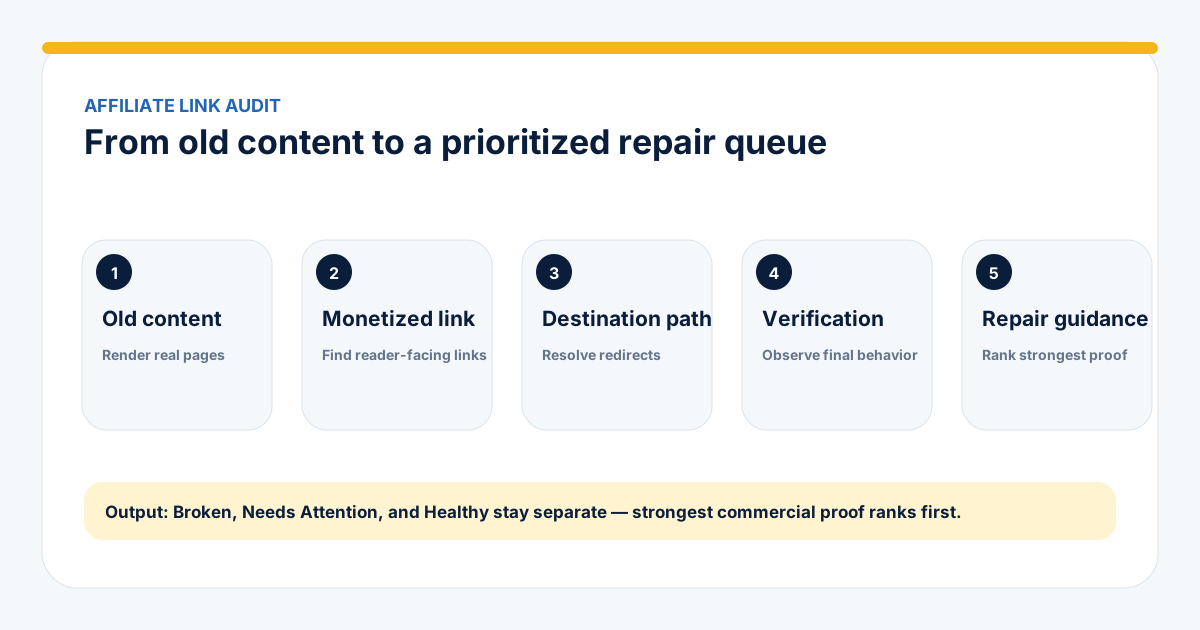
What the audit examines
Start from the published recommendation
Render real publisher pages and identify visible, clickable monetized recommendations in their editorial context.
Resolve the commercial path
Follow qualifying redirects and cloaked links far enough to establish the external merchant or network destination.
Verify what the reader reaches
Inspect final destination behavior, product or offer state, redirect intent, and other observable commercial evidence.
Separate certainty from uncertainty
Keep Broken, Needs Attention, and Healthy distinct so incomplete verification does not become a fabricated failure.
Return a prioritized repair queue
Rank the strongest commercial evidence first and provide a specific repair or review action where the evidence supports one.
The system preserves the publisher's original link, the resolved commercial destination, and the final destination reached during verification as separate pieces of evidence. That makes it possible to determine where the path changed rather than assuming the original URL tells the whole story.
What ordinary link maintenance can miss
The 2026 production benchmark covered 765 completed publisher scans. 366 publishers — 47.8% — had at least one customer-facing Broken or Needs Attention finding.
The two largest evidence classes were 530 tracking-path verification findings and 529 deep links resolving to merchant homepages. Confirmed unavailable products contributed another 308 findings.
Those results explain the product boundary. A conventional status check answers whether a URL responds. Affiliate Link Audit continues into destination resolution, commercial availability, destination intent, and evidence quality.
For the technical model, read Why 200 OK Doesn't Mean an Affiliate Link Is Healthy.
What a customer-facing finding contains
A useful finding should answer four questions without exposing scanner internals:
- What did the audit observe?
- How strong is the evidence?
- Why does the result matter to the recommendation?
- What should the publisher inspect or change next?
Customer output therefore translates technical evidence into Broken, Needs Attention, or Healthy and attaches a recommended next step when the evidence supports one.
The audit retains more technical detail internally than it presents publicly. Raw classifier names, unresolved diagnostics, provider behavior, and other operator evidence remain available for auditability without being turned into customer claims.
Who benefits most from this review
Publishers with established archives
Sites with enough historical monetized content that manually revisiting every recommendation is no longer practical.
See the production benchmarkReview and comparison publishers
Product and service recommendations can remain indexed after inventory, merchant URLs, or offers have changed.
See the technical modelTravel and rewards publishers
Cards, loyalty programs, booking partners, offers, and evergreen guides create a particularly dynamic destination surface.
Read the travel studyOperators who need a repair queue
The objective is not another raw crawl export. It is a ranked set of customer-facing findings with clear evidence and next actions.
View the reportFree sample: evaluate the evidence before purchasing
The free sample is a bounded proof of the audit model. It reviews up to 30 pages and presents a limited preview of the strongest customer-facing findings produced by that sample.
Its purpose is to let a publisher evaluate the quality of the evidence before paying for broader coverage:
Evidence quality
Can you see what the audit observed and understand why the classification was made?
Inspect the sample reportClassification discipline
Are confirmed failures kept separate from paths that require review rather than being collapsed into one problem count?
Review the evidence modelActionability
Does the finding lead to a repair, replacement, or clearly defined manual check rather than ending at “something may be wrong”?
Request a free sampleIf the sampled pages do not produce reportable findings, the customer-facing result should say so. If the site cannot be verified strongly enough for a responsible automated report, the workflow should report that limitation rather than defaulting to Healthy.
Full audit: $97 for broader coverage and the complete report findings
The $97 full audit expands beyond the free sample and returns the complete customer-facing findings produced by the paid scan rather than limiting the output to a three-finding preview.
The report is organized around the publisher's maintenance work:
- affected page and monetized recommendation;
- observed destination behavior;
- customer-facing classification;
- explanation of why the evidence supports that classification;
- recommended repair, replacement, or manual-review action where appropriate.
The full audit is not conditioned on finding a problem. It provides a broader, systematic review of eligible monetized content and reports the conclusions supported by the verification evidence.
What the audit deliberately does not claim
Affiliate Link Audit evaluates the observable public monetization path. It does not have automatic access to a publisher's private network ledger and therefore does not claim to prove whether a particular commission was credited.
It does not infer revenue loss from HTTP status alone. It does not call a path Broken merely because a merchant presents a CAPTCHA, times out, or limits automation. It does not present a bounded free sample as an exhaustive site crawl.
These boundaries preserve the distinction between observable evidence and unsupported inference.
Established content is an operating asset
New content receives attention during publication. Established content can continue earning for years with comparatively little maintenance visibility.
That creates a structural risk: the editorial page can remain relevant while the commercial destination beneath one recommendation changes independently. The page still ranks. The CTA still looks normal. The URL still responds. The failure remains invisible until someone checks farther down the path.
Affiliate Link Audit treats established monetized content as an operating asset that deserves the same kind of periodic verification as any other revenue-producing system.
See the evidence behind the service
The Affiliate Link Health Benchmark 2026 documents the production population and finding distribution behind the product's core premise. The Travel Publisher Link Health Research shows the same model inside a specific affiliate-heavy vertical.
The sample Affiliate Revenue Audit Report shows the customer-facing output. If the evidence model fits your maintenance process, request a free sample and evaluate it against your own site.