
Affiliate-link health extends beyond URL availability
An affiliate recommendation is not a single URL. It is a sequence of dependencies:
publisher content → monetized link → redirect or tracking path → merchant destination → product or offer
A request can succeed at the transport layer while that commercial sequence has already degraded. A product can become unavailable. A deep product or offer link can resolve to a merchant homepage. A program can expire. A tracking path can become difficult to verify. None of those conditions requires an obvious 404.
Affiliate Link Audit studies that broader path. The research published here comes from the same production evidence model used to create customer-facing audit findings.
The current benchmark population covers completed campaign scans from July 15 through August 17, 2026. Each publisher domain appears once. Free-sample and paid-customer scans are excluded so the published population remains methodologically coherent.
Research program
Affiliate Link Health Benchmark 2026
The flagship production benchmark: 765 completed publisher scans, the distribution of customer-facing findings, category comparison, methodology, and interpretation limits.
Read the 2026 benchmarkTravel Publisher Link Health Research
A vertical study of 588 travel rewards and points publishers, including the 811 → 618 → 588 population funnel and the destination patterns observed after completed scans.
Read the travel studyWhy 200 OK Doesn't Mean an Affiliate Link Is Healthy
The technical model behind the research: transport success, destination resolution, commercial intent, product availability, and verification are separate questions.
Read the technical guideSample Affiliate Revenue Audit Report
See how the evidence model becomes publisher-facing output: prioritized findings, explicit classification, and recommended next steps.
View the sample reportWhat we measure
Affiliate-link health is the condition of the monetization path a publisher is asking a reader to follow. The analysis separates several questions that ordinary uptime checks often collapse into one:
- Transport: did the request receive a usable response?
- Resolution: where did redirects or cloaking ultimately send the reader?
- Destination intent: does the final destination still correspond to the recommendation in the publisher's content?
- Commercial availability: is the referenced product, offer, program, or merchant path still usable?
- Verification quality: is the observable evidence strong enough to support a customer-facing conclusion?
Those questions produce different outcomes. A confirmed unavailable product and an incompletely verified tracking path should not be reported as the same kind of problem.
That is why customer-facing output distinguishes Broken, Needs Attention, and Healthy rather than forcing every observation into a binary pass/fail result.
How production evidence becomes a finding
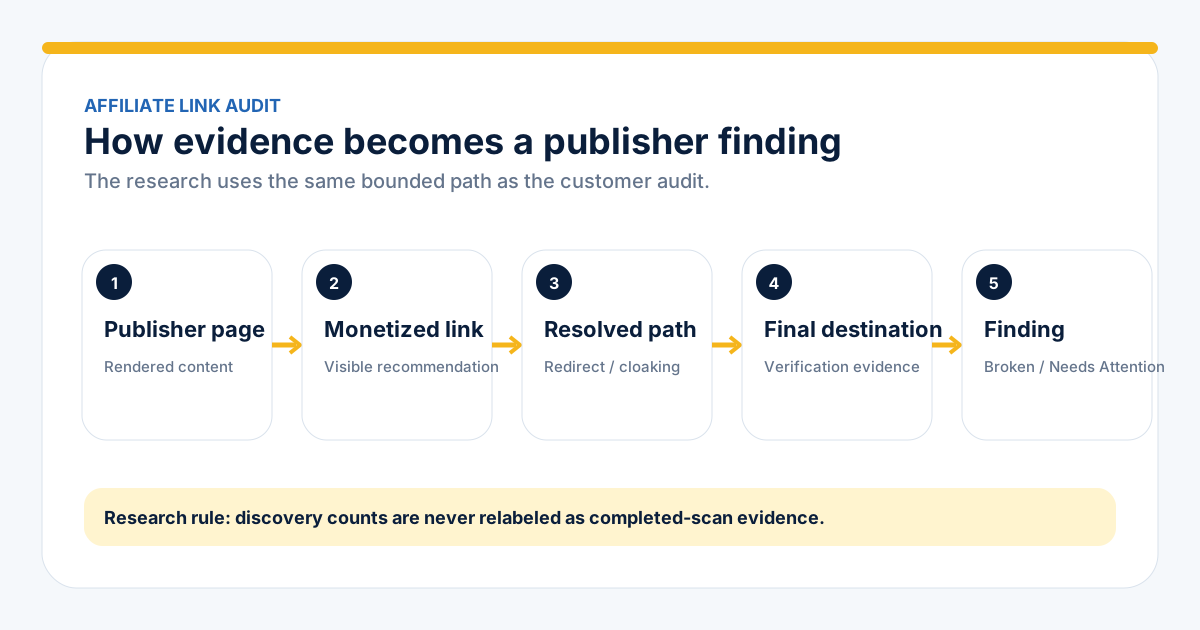
The scanner starts with rendered publisher content and visible, clickable monetized recommendations. It resolves qualifying link paths, establishes the external commercial destination, evaluates the destination behavior, and then applies an evidence gate before a result can become customer-facing.
That filtering matters. Raw web observations are not equivalent to validated publisher findings. The system retains far more technical evidence than it presents to a customer because internal diagnostics and customer conclusions serve different purposes.
Evidence and denominator standard
Every published statistic must answer four questions:
- What population does the number describe?
- What observation period produced it?
- What pipeline state qualified a record for inclusion?
- What conclusion does the evidence support — and where does inference begin?
For the 2026 benchmark, the denominator is 765 unique publisher domains with completed campaign scans. It is not the number of search results returned, discovered domains, contacts identified, campaign targets created, or outreach messages sent.
The travel study makes that separation visible: 811 discovered candidate domains → 618 promoted campaign targets → 588 completed scans. Only the 588 completed scans constitute the research denominator for the travel findings.
The research describes observable monetization-path behavior. It does not infer commission loss from a status code, equate verification uncertainty with confirmed failure, or present bounded page samples as exhaustive site inventories.
What the 2026 evidence changed in our operating model
The benchmark showed that conventional unreachable-page failures are only part of the maintenance problem.
Across 1,401 customer-facing findings, the two largest evidence classes were 530 tracking-path verification findings and 529 deep links resolving to merchant homepages. Confirmed unavailable products accounted for 308 additional findings.
That distribution shaped the product around destination intent and evidence quality rather than simple URL uptime. A publisher needs to know not only whether a request completed, but whether the recommendation still leads to the commercial destination it was written to support — and whether the evidence is strong enough to justify action.
Historical research record
Affiliate Link Health Benchmark 2026 is a record of a specific production population and observation period. It will remain dated 2026.
A later benchmark requires a new, reconciled dataset and a separate publication. Preserving each study as a historical record makes comparisons possible without rewriting prior evidence to appear current.
The research hub remains the stable entry point; dated benchmarks and vertical studies retain their own populations, periods, and limitations.
From research to publisher action
The research exists to make the maintenance problem measurable and inspectable. The product applies the same evidence discipline to an individual publisher's site: observe monetized recommendations, follow the commercial path, distinguish strong failures from uncertainty, and return a prioritized repair queue.
The sample Affiliate Revenue Audit Report shows how those conclusions are presented to a publisher. Affiliate Link Audit for Publishers explains the free sample, the $97 full audit, and the operating scope of the service.