
Executive finding
Between July 15 and August 17, 2026, Affiliate Link Audit completed campaign scans across 765 unique affiliate publisher domains. Those scans rendered 21,318 pages and evaluated 14,092 monetized anchors.
366 publishers — 47.8% of the scanned population — had at least one customer-facing finding classified as Broken or Needs Attention.
The 47.8% figure is a publisher-level finding rate, not a percentage of links that failed. The 1,401 findings are individual link-level results that passed the customer-facing evidence gate.
The dominant findings were not simple unreachable pages
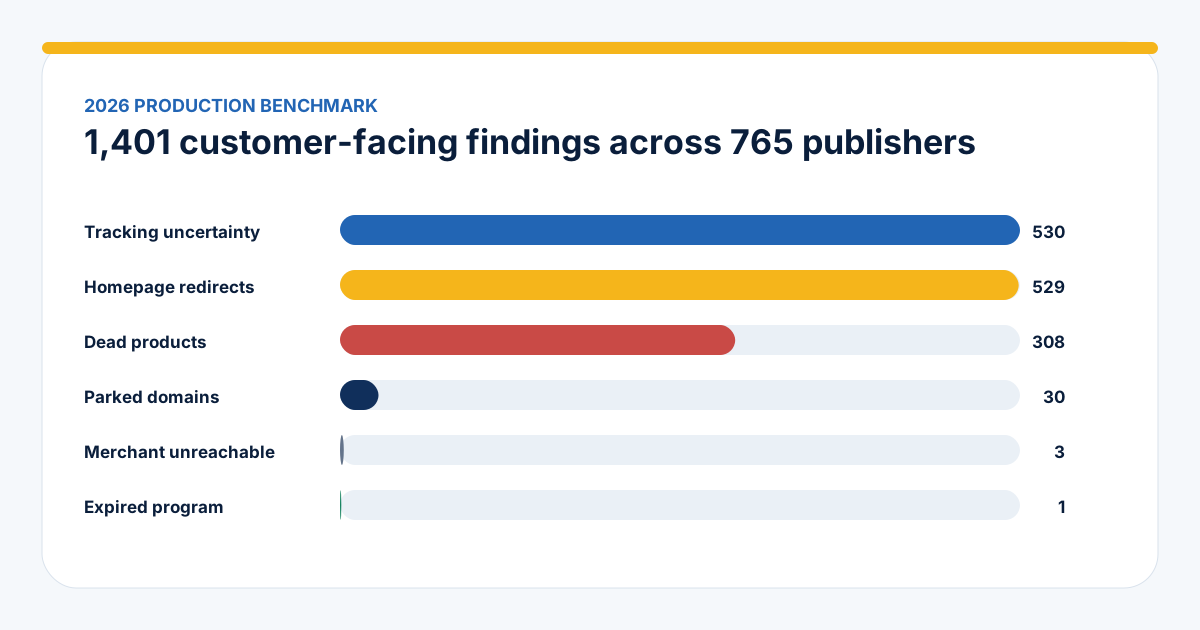
The 1,401 findings were distributed as follows:
- 530 tracking-path verification findings — the affiliate or tracking path could not be verified with enough confidence to classify it as Healthy;
- 529 homepage-redirect findings — a deep product or offer path resolved to the merchant's generic homepage instead of preserving the intended destination;
- 308 unavailable-product findings — the destination provided strong evidence that the referenced product was unavailable or discontinued;
- 30 parked-domain findings — the commercial destination had become a parked or for-sale domain;
- 3 unreachable-merchant findings — the merchant destination could not be reached during verification;
- 1 expired-program finding — the evidence supported an expired affiliate-program path.
A homepage redirect can complete successfully at every HTTP hop while no longer fulfilling the publisher's recommendation. A tracking path can reach a merchant destination while still leaving unresolved questions about whether the path is intact. Those outcomes require different classifications and different publisher actions.
Classification reflects evidence strength
The benchmark contains 339 Broken findings and 1,062 Needs Attention findings.
The difference is intentional. Affiliate Link Audit distinguishes evidence that supports a confirmed commercial-path failure from evidence that warrants review but does not justify a definitive failure claim.
Broken
Strong destination evidence supports a repair decision, such as an unavailable product, parked domain, or expired program.
See report examplesNeeds Attention
The path deserves publisher review, but the observable evidence does not justify calling it definitively Broken.
Understand the evidence modelHealthy
The observed destination behavior supports the expected path strongly enough to remain outside the repair queue.
See what the audit checksThis distinction is operational, not cosmetic. A confirmed unavailable product belongs ahead of a path whose verification was limited by bot protection, inconsistent redirects, timeouts, or incomplete public evidence.
A production finding, reduced to its decision logic
The example below uses a real unavailable-product evidence shape represented in the benchmark while removing publisher and product identifiers.
From 1.37 million anchors to 1,401 customer-facing findings
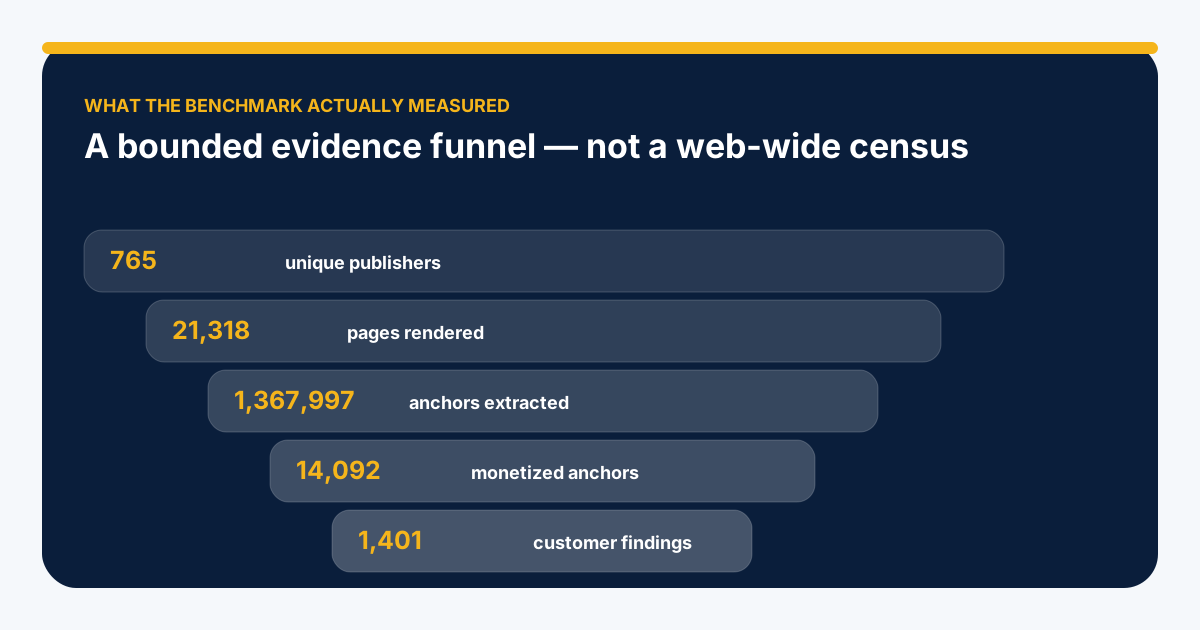
Across the 765 completed scans:
- 21,318 pages were rendered;
- 1,367,997 anchors were extracted;
- 14,092 anchors were identified as monetized and evaluated;
- 1,401 results passed the customer-facing Broken or Needs Attention evidence gate.
The reduction is important. The audit does not turn every outbound link or scanner observation into a customer issue. A result must first represent a visible monetized recommendation, resolve to a valid external commercial destination, survive verification, and meet the evidence threshold for customer presentation.
That separation between operator evidence and customer interpretation is central to the product. Diagnostic uncertainty remains available internally without being promoted into an unsupported customer claim.
Two publisher populations, different observed rates
The benchmark contains two campaign categories scanned through the same Gen 4 pipeline and verification engine:
The difference is descriptive rather than causal. Merchant mix, content age, link structures, program behavior, and campaign population can all influence the observed result. The dataset does not establish that one publishing category is inherently better maintained than another.
It does establish that customer-facing monetization-path findings were present at meaningful rates in both populations.
Interpretation limits
The benchmark supports conclusions about the observed campaign-scan population. It should not be generalized beyond what that evidence can support.
Three limits are material:
- each completed scan rendered up to 30 pages, so the study is a bounded sample rather than an exhaustive crawl of every monetized page on each domain;
- tracking-path uncertainty is a verification result, not direct evidence that a specific commission was lost;
- free-sample and paid-customer scans are excluded from this dataset.
Those limits do not weaken the result. They define the population to which the result applies.
Methodology and denominator
The benchmark denominator is publisher domains that were campaign targets with a completed scan (scan_requests.status = 'complete'). Each domain appears exactly once; the production evidence review confirmed zero duplicate completed domains in this dataset.
The observation period begins with the earliest completed scan on July 15, 2026 and ends with the latest completed scan on August 17, 2026.
Customer-facing findings are individual scan-result rows that reached the valid-destination and customer-evidence gates and were classified for the publisher as Broken or Needs Attention. The underlying production statuses remain more granular for operator diagnostics, but the public research uses the customer-facing interpretation layer unless an internal field is required to explain methodology.
All scans in the period used the same Gen 4 pipeline and verification engine. No known schema or verification-engine change within the observation window invalidates the aggregation.
Discovery results, candidate domains, contact records, campaign targets, email sends, free samples, and paid customer scans are different populations. None is interchangeable with the 765 completed-scan denominator.
Publisher implication
The benchmark does not support the claim that “almost half of affiliate sites are broken.” It supports a narrower and more useful conclusion:
In this production population, 47.8% of scanned affiliate publisher domains contained at least one customer-facing monetization-path finding, and most findings were not conventional unreachable URLs.
For publishers managing established evergreen content, that argues for routine review of destination behavior and evidence quality, not only periodic checks for HTTP errors.
Read Why 200 OK Doesn't Mean an Affiliate Link Is Healthy for the technical model, or open the sample report to see how this evidence is translated into a publisher repair queue.
Historical status
This benchmark remains permanently associated with its 2026 observation period. A future benchmark requires a separately reconciled population, publication date, and methodology record rather than silently replacing this dataset.